

Best ad spy tools in 2026: an honest comparison of prices and platforms
LLucas Reda · 5 Nov · 10 min
Everyone reads the same winning product lists, and they go stale in weeks. How to read the ad itself (days live, copies, advertisers, countries) to see what is selling now.
Short answer: you won't find a winning product in a "15 products to sell this month" list, because thousands of people read that list at the same time and by the time it reaches you it's old news. You find winning products by reading the ad: how many days it has been live, how many copies of the same creative are running, how many different advertisers sell the same product, in how many countries, and what kind of offer it uses. You can check all of this for free in the Meta Ad Library, and this guide walks you through it step by step.
Search for "winning products for dropshipping 2026" and you get a wall of lists. Some are good. They all share one flaw: they hand you the answer without the method, and the answer expires. The method doesn't.
A winning product list is a snapshot. Someone looked at the market on one day, picked what was selling and published it. A lot happens between that snapshot and your first campaign:
The ad is live data. Nobody pays for weeks of media on a product that loses money. If an ad stays live, gets duplicated and shows up across several stores, someone is making money with it right now. So you won't find a product list here. You'll learn how to build your own, every day, from public data.
No single sign is enough. A winning product stacks several. Think of it as a score: the more boxes it ticks, the stronger the case.
The most honest signal. The Meta Ad Library shows the date the ad started running ("Started running on…"). If it has been live for weeks, it survived several budget reviews. In the first days almost everything is a test; after a few weeks, whatever is left passed the filter. We go deeper in days live, the most honest signal.
When the card says "X ads use this creative and text", the advertiser duplicated the same creative across several ad sets or accounts. Duplicating is the most common way to scale. A creative with many copies and weeks of runtime is almost always a creative that pays for itself. More in what creative copies mean.
This is the most overlooked signal and the most useful one for product research. If three, five or ten unrelated pages sell the same product at the same time, demand is proven. One store can get lucky or have a big budget. Several stores competing show the product sells for more than one person. It is also your saturation alarm: if there are dozens, you're late.
An advertiser who keeps shipping new creatives for the same product is investing in it. Nobody shoots new video for a product that doesn't sell. If you see one creative from two months ago and three more from this week, the product is in its scaling phase.
When the same advertiser runs the offer in the US, the UK, Canada and Australia, or across several European markets with translated copy, the operation made the numbers work in at least one market and is expanding. It's a double clue for you: the product was validated somewhere and may be on its way to your market.
Read the offer, not just the product. In the US and UK, winning ads usually lean on free shipping, bundles ("buy 2, get 1") and a clear guarantee, paid by card. In Eastern Europe and much of Latin America, the same kind of product often sells with cash on delivery, a short order form instead of a cart. If you sell with card payments, a product that only scales with COD in Romania tells you little. We explain how to spot COD offers in COD in Europe: how to read the ads.
Products that scale through ads can almost always be understood in three seconds of video: the problem, the product solving it, the result. If the strongest ad is a demo video, the product has visual pull. If it only works as a catalog photo, the sale depends more on price than on the product.
Check where the ad goes. A store with a single product page, quantity offers, reviews and a clear delivery promise is an operation built to scale. An ad that sends traffic to a big marketplace tells another story: the seller depends on the platform and margins are usually tighter.
Days live answer "does this sell?". Copies answer "how much is the advertiser betting on it?". The number of advertisers answers "does it sell for more than one store?". You need all three.
You can do all of this without paying anything, right in the Meta Ad Library. It takes about 30 minutes the first time and less once you get the hang of it. For a shorter daily routine, see how to mine the Ad Library in 15 minutes.
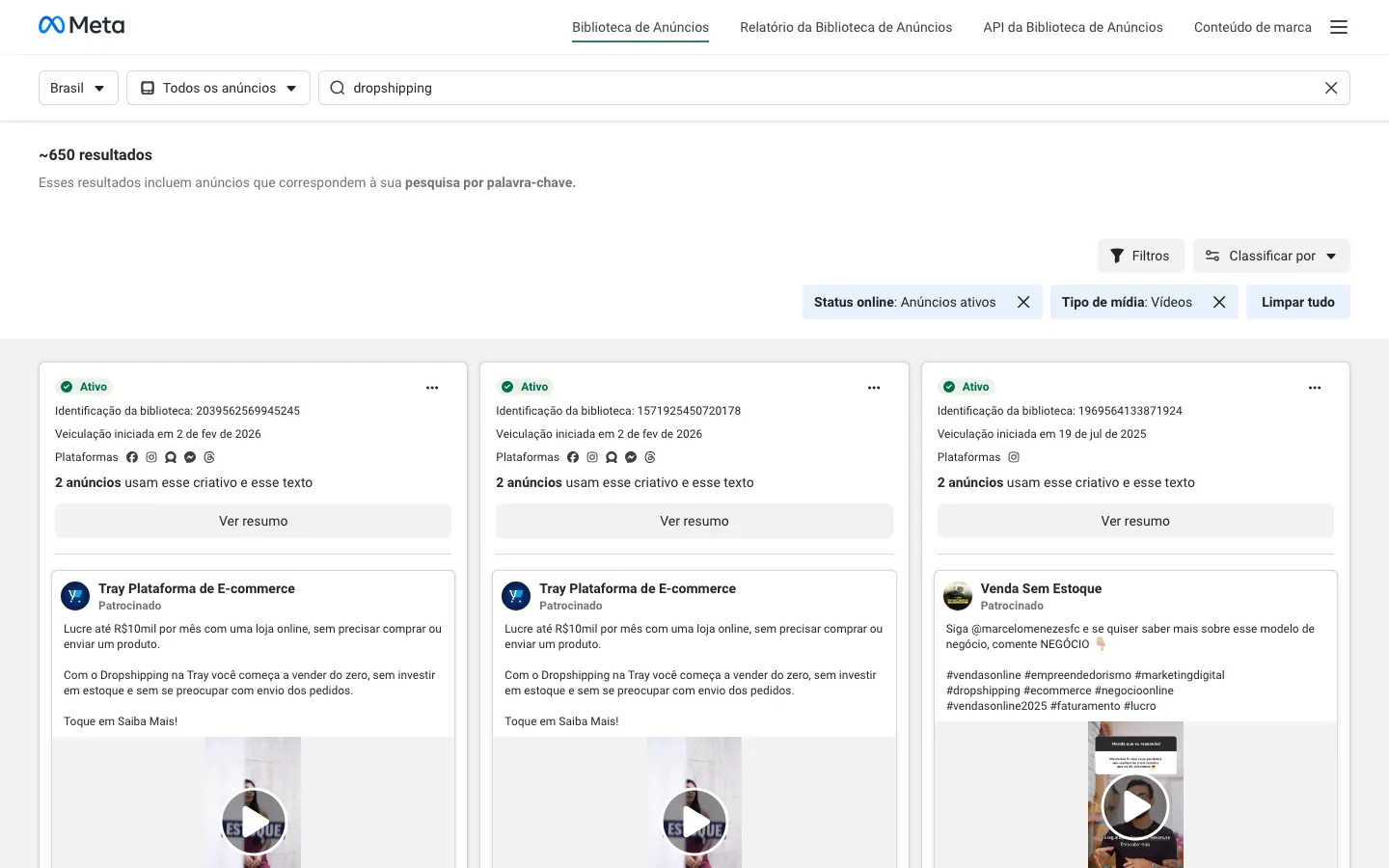
We searched "dropshipping" on purpose, to show the problem from step 3: nearly everything that comes up is platforms and courses selling the idea of dropshipping, not products. That's why you search for the offer phrase. The English interface shows the same fields in the same place.
If you want to check TikTok too, the logic is the same, but the official library covers fewer countries; we explain it in the TikTok ad library. And to confirm an offer is actually scaling and not just being tested, read scaling offers: how to find them.
Finding the product is half the job. Before you buy stock or launch a campaign, run it through five filters. The general product selection criteria that serious guides repeat (for example, Shopify's dropshipping guide on picking products, checked in October 2026) come down to a price point that fits the support you can give, products that are hard to find locally, items that don't get a new model every year, and staying away from what is already sold everywhere. Shopify also recommends ordering samples before you commit. Here's how that maps to the ad:
The sweet spot is the middle: more than one advertiser (demand is proven), but not so many that the audience has seen the product ten times. There is no magic number; compare against other products in the same niche and country.
Open the pages of three different advertisers. Look at the price, quantity offers, reviews, guarantee, promised delivery time and returns policy. The point isn't to copy the page; it's to understand the market standard. Your version has to match it or improve something specific. That's the copy the structure, not the creative method.
Do the math before you fall in love. Selling price, minus product cost, minus shipping, minus ad cost per completed order, minus refunds, returns and chargebacks. If nothing is left, the product may be selling well for someone else and still not work for you. Compare the advertisers' price with what it costs you to source the product.
In the US and UK, buyers compare your delivery promise with what they get from big retailers. A product that ships from overseas in a few weeks needs a strong reason to wait. Check whether a supplier can stock it closer to your market, and at what cost. If you run cash on delivery in Europe or Latin America, part of the orders get refused at the door, so confirmation and courier choice weigh heavily on the result.
Before you invest, check that the product can be advertised. Meta's Advertising Standards have prohibited and restricted categories: products that are illegal locally, weapons, tobacco, drugs and pharmaceuticals, hazardous materials, health and wellness with its own rules, and the sale of counterfeit goods, which falls under intellectual property infringement. An ad being live today doesn't mean the product is allowed; it may simply not have been reviewed yet.
The product had five advertisers two months ago and has forty today. The audience has seen the video, the price dropped and cost per purchase went up. If almost every ad for the product is months old and no new advertisers are launching fresh creatives, the wave has probably passed.
A video with lots of reactions isn't a winning product. Reactions can be bought, filtered or come from people who would never buy. Days live and copies are harder to fake because they cost money.
Selling in Germany guarantees nothing in the US, and vice versa. Price, payment habits and shipping expectations change. Use the other country as a clue, not as proof.
If the product belongs to a well-known brand, or imitates one, it isn't a winning product: it's a liability. Meta treats counterfeit sales as intellectual property infringement, and your ad account is what pays for it.
Health products with big promises, supplements, weapons or anything restricted can work for a few weeks and then take the account down. If your niche is health, don't copy another advertiser's copy: describe the angle in your own words and follow the rules.
Downloading someone else's video and running it as yours is the fastest way to get into trouble and into a price war. What you copy is the structure: the hook, the demo, the proof, the offer. You rebuild the asset. The six creative angles help you find yours.
Use this table for every candidate. If it ticks fewer than five rows, keep looking.
| Signal | Where to look | Counts in favor | Red flag |
|---|---|---|---|
| Days live | "Started running on" | Weeks live, still active | Everything under a week |
| Copies | "X ads use this creative and text" | More than one copy of the main creative | A single standalone ad |
| Different advertisers | Search by product name | Several unrelated pages | One page only, or dozens |
| Fresh creatives | Advertiser's page | New videos for the same product this month | Only old creatives |
| Countries | Advertiser's page / per-country search | Expanding into new markets | Only in a market that isn't yours |
| Offer | Ad copy and landing page | Matches how you'll sell (card or COD) | Offer you can't replicate |
| Format | Media type | Demo video | Catalog photo only |
| Landing page | Click the ad | Own store, quantity offers, clear delivery promise | Big marketplace with crushed prices |
| Margin | Your own math | Margin left after ads and refunds | Doesn't work even in the best case |
| Policy | Meta Advertising Standards | Product allowed | Restricted, trademarked, knockoff |
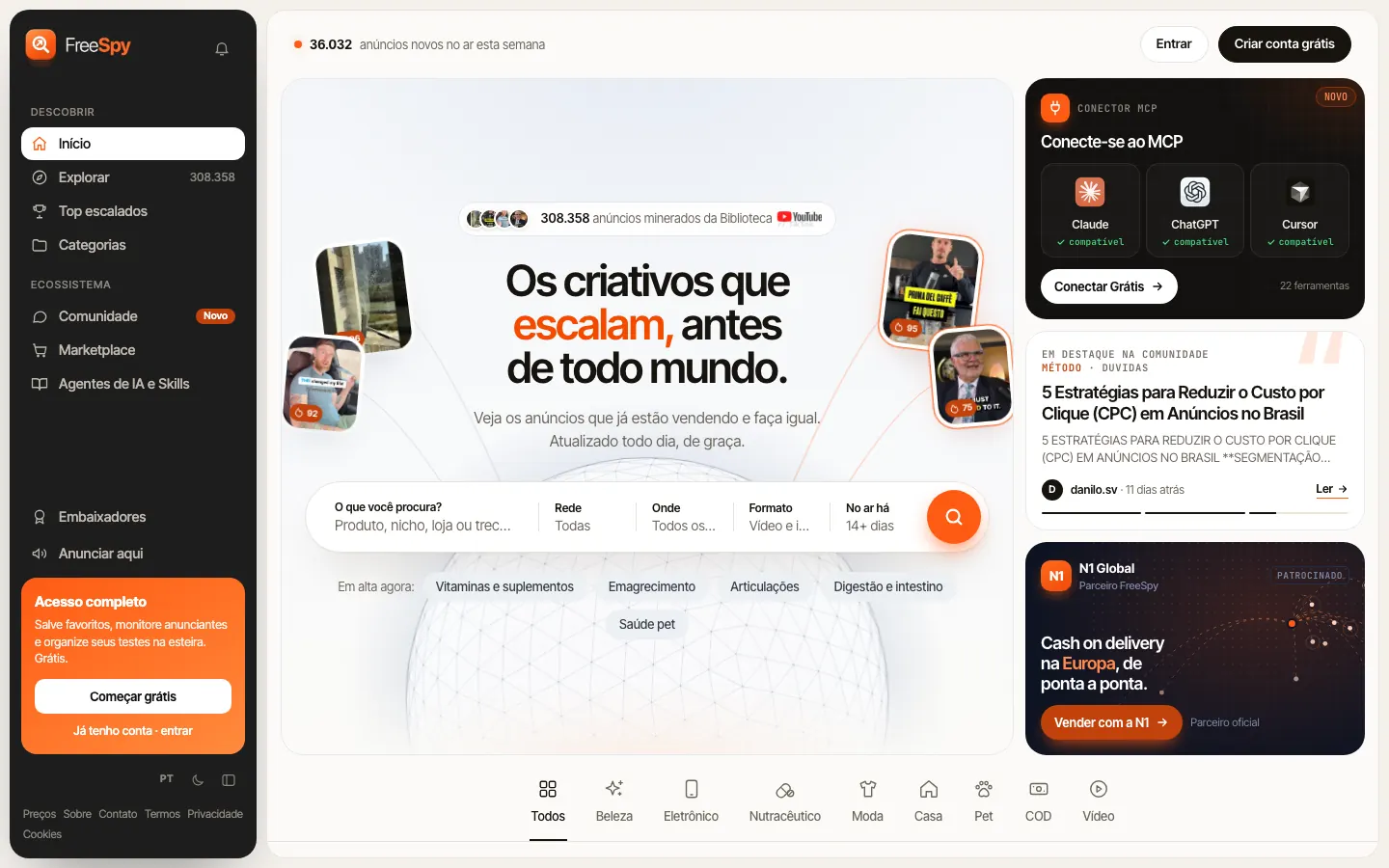
FreeSpy is our product, so read this with that in mind. It does the reading described above every day: it reads public ads from Meta, TikTok and YouTube, groups copies of the same creative and shows days live, copies and a 0 to 100 index for each advertiser.
For product research, the shortcut is Top Scaled. Under "Ranking of", switch to Products. Then:
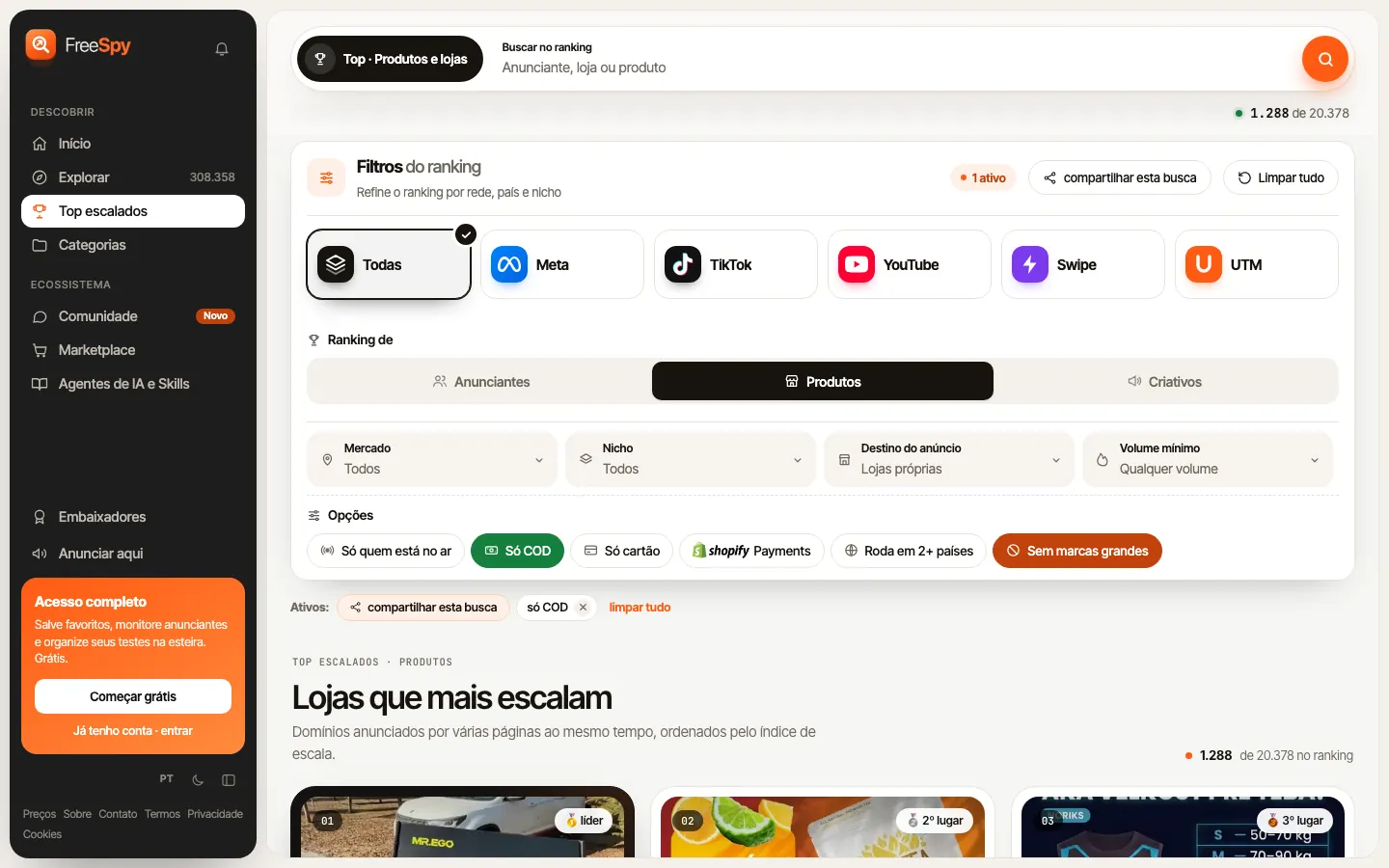
In Explore you can go ad by ad with the same filters: time live, creative copies, video only and policy risk, which helps with the last row of the checklist. On the Home page, Going live now shows ads that went live in the last three weeks and have already been duplicated (the right moment to get in early), and Validated for 90+ days shows what has proven it lasts.
What FreeSpy doesn't do, so you don't expect too much:
The account is free forever and doesn't ask for a card. With it you save finds into collections, follow up to 5 advertisers in the Store Monitor and move each product through the Test Board, from "Found" to "Scaling". Pro is optional, for people who need higher limits (see plans). Create your free account.
They change every week, and in every market. That's why we don't publish a list: anything we posted today would be stale by the time you read it. The method in this guide gives you your own list, up to date, for the market you sell in.
In the Meta Ad Library: pick your country, search offer phrases like "free shipping" or "buy 2 get 1", keep active ads and video, and shortlist what has weeks of runtime, several copies and several advertisers. FreeSpy does that reading every day, also for free.
There's no exact number. Several weeks live, with copies and more than one advertiser, is a good sign. A single old ad with no copies is worth less than a three-week-old ad duplicated several times.
Yes, the same signals apply: runtime, repeated creatives and several sellers. The official TikTok library only covers some regions, so read our guide to the TikTok ad library before you start.
If dozens of advertisers run the same video, prices keep dropping and hardly any new creatives appear, you're late. Look for products with a handful of advertisers that have just started duplicating.
A list tells you what sold. The ad tells you what's selling. Read the ad.
Everything on the blog is on the platform, with days live, copies and the original media. Free.