

Days live: the most honest signal that an ad is selling
LLucas Reda · 11 Oct · 2 min
What a scaling ad is, the 5 public signals you can check, a step-by-step in the Meta Ad Library, and how to confirm it in 3 to 7 days before you test.

Short answer: an ad is scaling when the advertiser keeps putting more budget behind it because it sells. You can see that from the outside through five public signals: lots of active ads from the same advertiser, the same creative duplicated across several ads, weeks of days live, several countries, and several Pages sending traffic to the same store. One signal on its own is misleading. To confirm, write the numbers down today and check again in 3 to 7 days. If the active ad count went up or held high, the offer is scaling. If it dropped, it was a test or it has already burned out.
Most content on "scaling ads" or "winning ads" is either a YouTube video or a tool's homepage. This guide is the written version, with criteria you can apply: what to look at, in what order, what usually fools people, and how to go from a find to your own test without cloning anyone.
In paid media, scaling means increasing the budget on a campaign that's already profitable. Nobody scales something that loses money. So a scaling offer is, in practice, an offer that has passed the advertiser's own tests and is now getting more spend.
The word "offer" matters. It isn't just the product, and it isn't just the video. It's the whole package: product, price, promise, payment method, landing page, and the creative that gets people there. Two stores can sell the exact same product and only one of them scales, because its offer is better.
What a scaling ad is not:
The core idea is simple: money leaves a trail. Advertisers who scale launch more ads, duplicate the winning creative, keep everything running for weeks, and open new markets. All of that is visible in public ad libraries.
The first signal is volume. An advertiser with three active ads is testing or maintaining. One with dozens of active ads for the same offer is spending for real. Count active ads only. Inactive ads are history.
When advertisers find a creative that works, they rarely just raise the budget on one ad. They launch the same video across several ad sets, audiences, and campaigns. In the Meta Ad Library that shows up as several ads with the same media and the same text. We go deeper in what creative copies mean.
Every day live is a day of spend. Ads that lose money get switched off within days. A creative that's still running after three, four, six weeks has survived several rounds of cuts. It's the hardest signal to fake, which is why we call it the most honest signal.
One detail most people miss: the "Started running on" date applies to that ad, not to the creative. When an advertiser duplicates a video, the new copy gets a new date. To know the real age of the creative, find its oldest copy.
An advertiser who launches the same offer in a new country has already validated the first one. The same creative with subtitles in another language, or the same funnel on a local domain, is horizontal scaling. You'll see this a lot with brands that start in the US and roll out to the UK, Canada, and Australia, and with cash on delivery offers across Europe; see how to read COD ads in Europe.
Larger operations run the same offer from several Facebook Pages to spread account risk and reach different audiences. If you find three or four Pages with different names all sending traffic to the same domain or landing page, you're looking at a whole operation scaling, not a single ad.
No single signal is proof. Volume without time can be a test. Time without volume can be a minimum budget. Scaling is when three or more signals show up together and hold for days.
You can do all of this for free in the Meta Ad Library. It takes time, but it teaches you to read the market. Set aside about 40 minutes the first time.
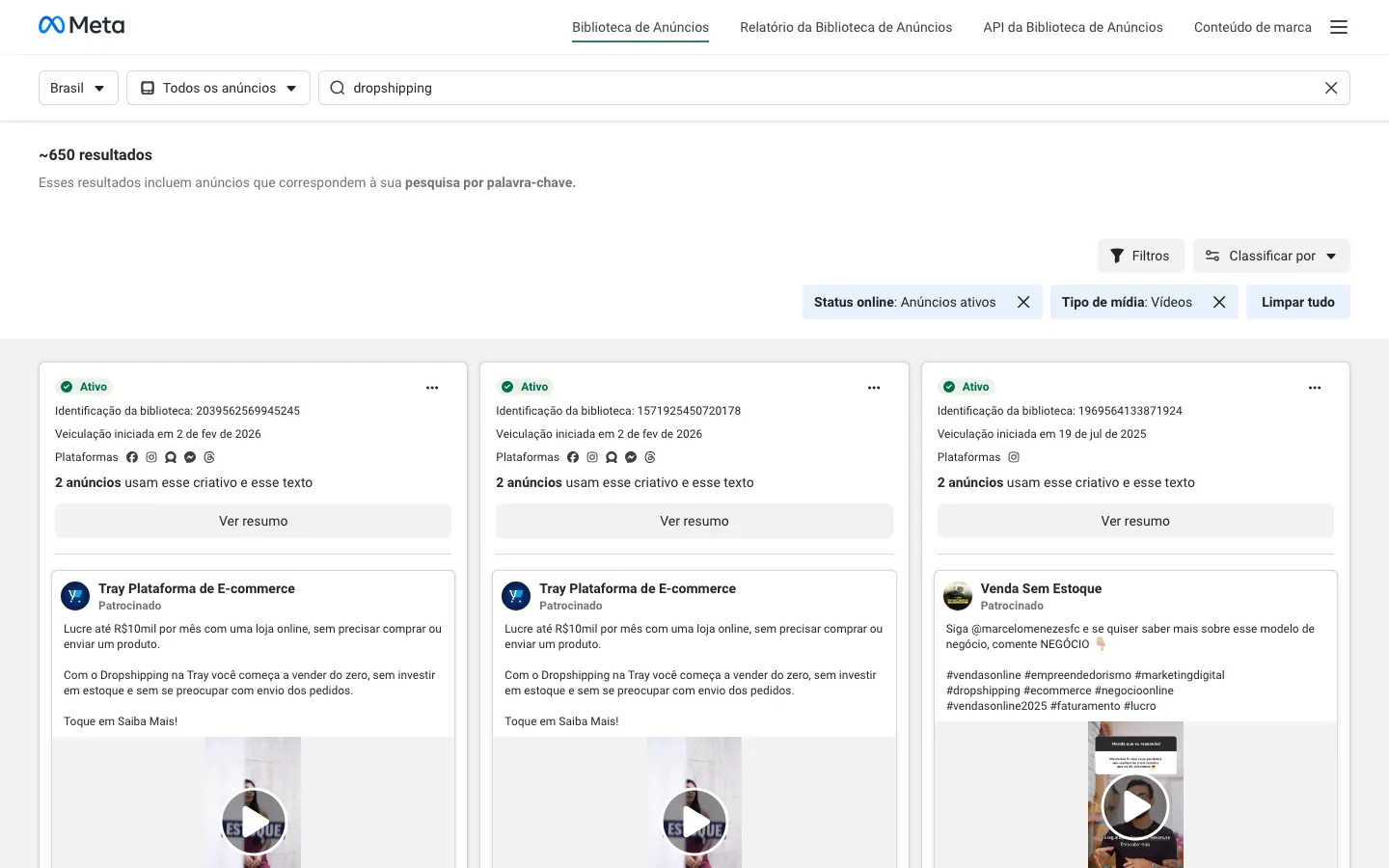
In the screenshot above, the first two cards come from the same advertiser, with the same video, starting on the same day. That's already a copy. Two copies don't say much yet. What you're looking for is that number growing and spreading to other Pages and countries.
If you've never used the library, the short routine in how to mine the Ad Library in 15 minutes a day helps you build the habit.
If you sell in Europe, there's a bonus: Meta shows more information about ads delivered in the European Union, including reach data, and keeps those ads archived for a year after their last impression (Meta, Ad Library tools, checked October 2026). For commercial ads shown only in the US and other non-EU markets, that extra data isn't available.
| Signal | What it means | Trap |
|---|---|---|
| Many active ads | The advertiser is spending now | Could be mass testing: lots of different creatives that die fast |
| Same creative in several copies | A winning creative being multiplied | Two or three copies can just be different audiences in one test |
| Many days live | It survived several cuts; it pays for itself | A minimum budget running for months, or a forgotten ad |
| Several countries | A validated offer opening new markets | A global brand that advertises everywhere by default |
| Several Pages, same store | A whole operation scaling | An agency or unrelated resellers using the same assets |
| Count rising over 3 to 7 days | Scaling in progress | A new batch of tests also raises the count; check whether the new ads repeat the creative |
| Count dropping | End of a test or saturation | A weekend pause or an account swap; check once more before you drop it |
Four situations fool almost everyone at the start.
The advertiser launches 50, 80, 100 ads at once, each with a different hook, image, and text. The active count looks huge, but no creative repeats and nearly all of them die within a week or two. That's what we call a tester. Worth watching, because one of those creatives may survive and become a champion, but it isn't a scaling offer yet.
Well-known brands keep awareness ads running for months, in many countries, in many versions. That's brand spend, not an offer test. It runs on a different return model, different media costs, and existing brand recognition. Copying the structure of a big brand rarely works for a smaller advertiser.
A creative with 120 days live and dozens of copies looks perfect. But if, on your second visit, half the copies are gone and nothing new came in, the advertiser is winding down. The audience has seen it. Arriving at the end of the curve is the most expensive way to be wrong.
A single ad can run for six months while spending very little a day. It "pays for itself" in the sense that it doesn't lose money, but it isn't scaling. If the Page has one or two ads and no copies, time live alone isn't enough.
A useful question for every find: "if this advertiser doubled their budget tomorrow, what would I see in the library?" If the answer is "more copies, more countries, more Pages", and you're already seeing that, it's scaling.
A screenshot shows a moment. Scaling is a curve. The cheapest way to avoid a bad test is to record the same advertiser two or three times before you spend a dollar.
Day 0: the snapshot. For each candidate, note:
Day 3: the first check. Count again. What you want to see:
Day 7: confirmation. If the count rose or held high, with new copies coming in and the old ones still live, the offer is scaling. If it dropped sharply, it was a test or it's near the end.
A hypothetical example to make it concrete. A kitchen gadget Page has, on day 0, 14 active ads, 9 of them with the same video, and the oldest copy started 35 days ago. On day 3 there are 19 active ads, 13 with the same video, plus two new copies targeting the UK. On day 7, 22 active ads and a second Page sending traffic to the same store. That's scaling: rising volume, a repeated creative, accumulated time, and expansion. Now picture the opposite: 40 active ads on day 0, 40 different creatives, and 12 active on day 7. That's a tester clearing the table.
Why 3 to 7 days? Fewer than three days doesn't give the advertiser time to react to results. More than seven, and you risk being late to a creative that was on the rise. For offers with many days live, a week is enough. For a new creative that's already duplicated, check back in three days.
You've confirmed the offer is scaling. The most common mistake now is downloading the video, swapping the logo, and launching it. You enter the same auction, with the same creative, against someone with weeks of data, a trained pixel, and a warm audience. It almost always dies fast, and it can also get you a copyright complaint.
What's worth copying is the structure:
Then make your own piece. Same structure, different hook, different proof, your own voice. We explain the method in copy the structure, not the creative. In health and supplement niches, take extra care: describe the angle for yourself and write your copy from scratch, within the platform's rules.
FreeSpy is our product, so read this with that in mind. Every day, overnight, it does the manual part of the steps above: it reads public ads from Meta, TikTok, and YouTube, groups copies of the same creative, and calculates the signals for you.
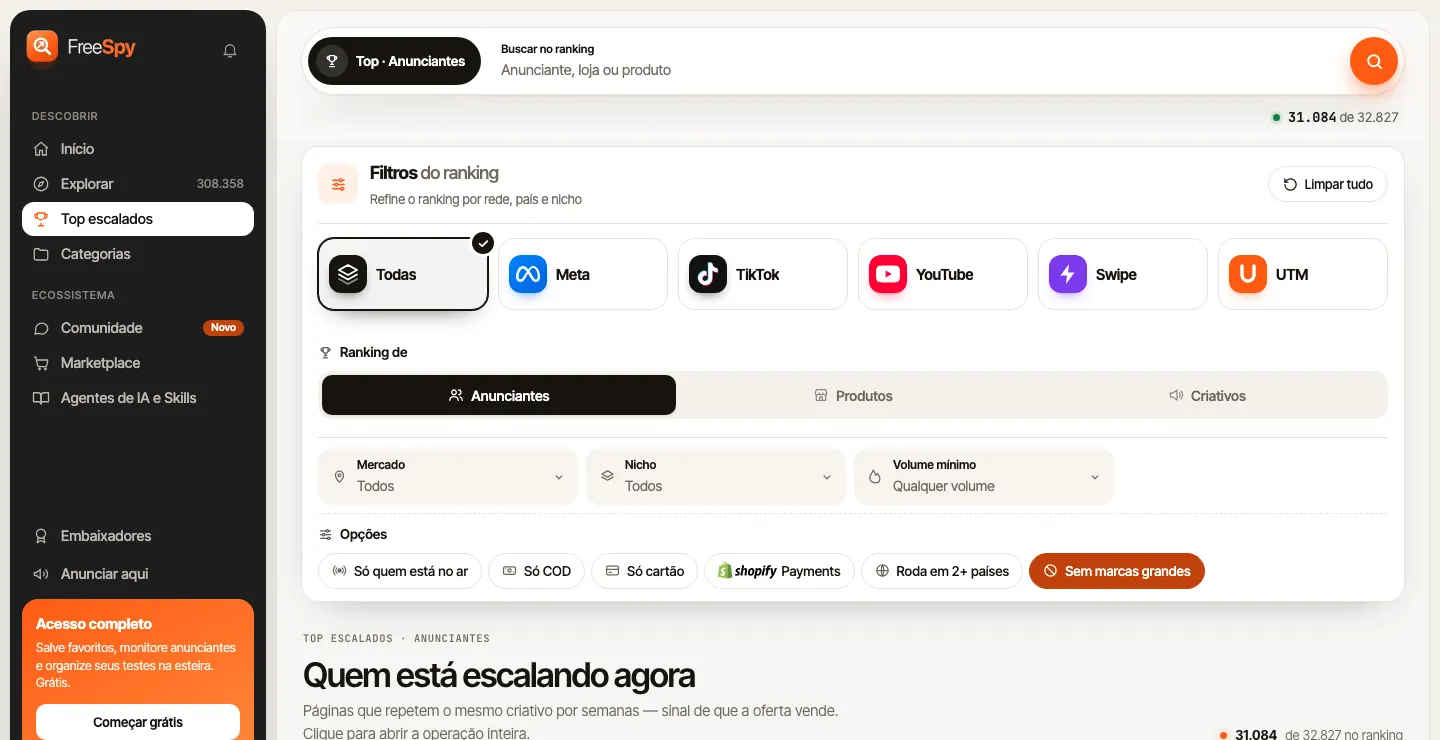
On the home page, two rows answer this guide's two questions directly. Going live now shows ads that went live in the last 3 weeks and have already been duplicated: a test that worked, still early. Validated for 90+ days shows creatives that have been running for more than three months. The search bar at the top already filters by network, country, format, and time live.
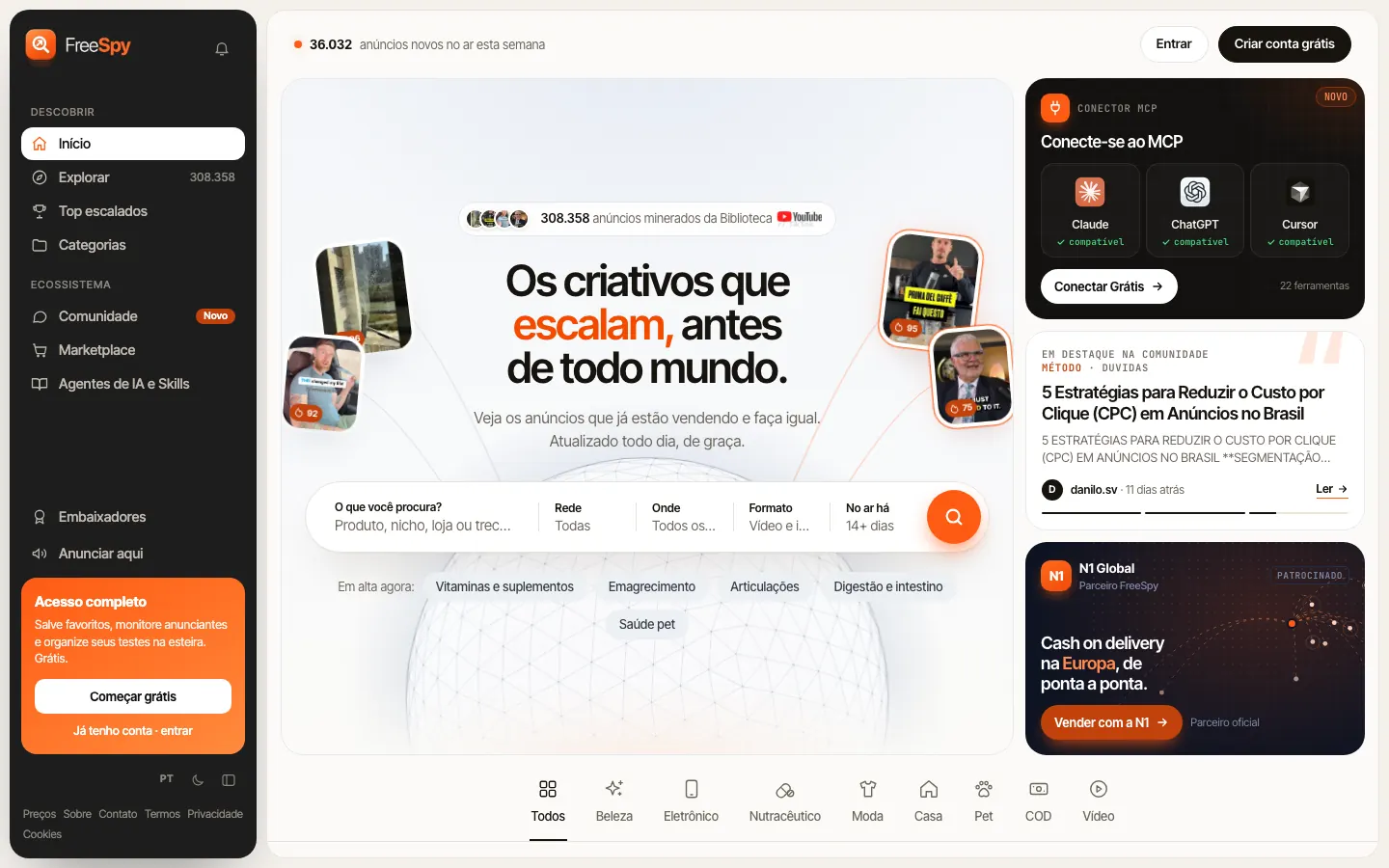
What FreeSpy doesn't do: it doesn't show how much an advertiser spends, sells, or earns. No public data does. Metrics are estimates based on public ads and don't guarantee sales. TikTok and YouTube coverage is smaller than Meta's; for TikTok, see also what the TikTok ad library shows in each country.
The account is free forever and doesn't ask for a card. Start with Top Scaled or Explore, filtered by your niche and country. If you want higher limits, Pro is optional (pricing).
The mistakes we see most:
Quick checklist for each candidate:
Seven yeses and it's a test candidate. Fewer than that, it goes back on the watch list.
Look for several signals at once: many active ads from the same advertiser, the same creative duplicated, weeks of days live, multiple countries, and several Pages sending traffic to the same store. Then check again 3 to 7 days later. A rising or steady count with new copies means it's scaling.
In the Meta Ad Library, pick a country, search with words from the ad copy, filter to active ads and videos, look for the line "X ads use this creative and text", and open the advertiser's Page to count active ads. Write it down and come back in 3 to 7 days.
There's no magic number. A few weeks live shows the ad survived the first cut; 90+ days points to a validated offer. Time live only means scaling when it comes with copies and rising volume.
No. Finding them means spotting what works and understanding why. Cloning means copying the ad and the page. What works is copying the structure (angle, promise, proof, format, and funnel) and making your own piece.
Not for commercial ads. The library doesn't show spend. In the European Union you get estimated reach, but not spend. Copies, days live, and volume are the best public indicator of how much someone is betting.
No. The Meta Ad Library is free and this guide works there. A tool only saves you the time of counting copies and checking back every day. FreeSpy does that in a free account, no card required.
Scaling isn't a screenshot. It's a curve that keeps rising for days. Write it down today, check again in three, confirm in seven, and only then make your version.
Everything on the blog is on the platform, with days live, copies and the original media. Free.